
In the era of the Fourth Industrial Revolution (Industry 4.0), the manufacturing landscape is evolving rapidly. The demand to reduce production costs while simultaneously scaling up mass production makes manual methods no longer relevant.
Table of Contents
This is where automation in the factory environment (industrial automation) plays a crucial role. It is not just about replacing human labor with machines; modern automation is now integrated with the Industrial Internet of Things (IIoT) to create intelligent systems (Smart Factories). For decision-makers in the manufacturing sector, understanding the automation ecosystem is the first step to ensuring the business remains competitive and scalable in the modern industry.
What is Factory Automation?
Technically, factory automation is the integration of technologies—ranging from mechanical hardware and precision sensors to analytical software—to run operational processes autonomously with minimal human intervention.
This system is designed not only to execute repetitive physical tasks but also to process operational data in real-time. The result is a production ecosystem with high-precision consistency, free from fatigue risks, and drastically reduces the human errors that often trigger material losses.
Core Components and How Automation Systems Work
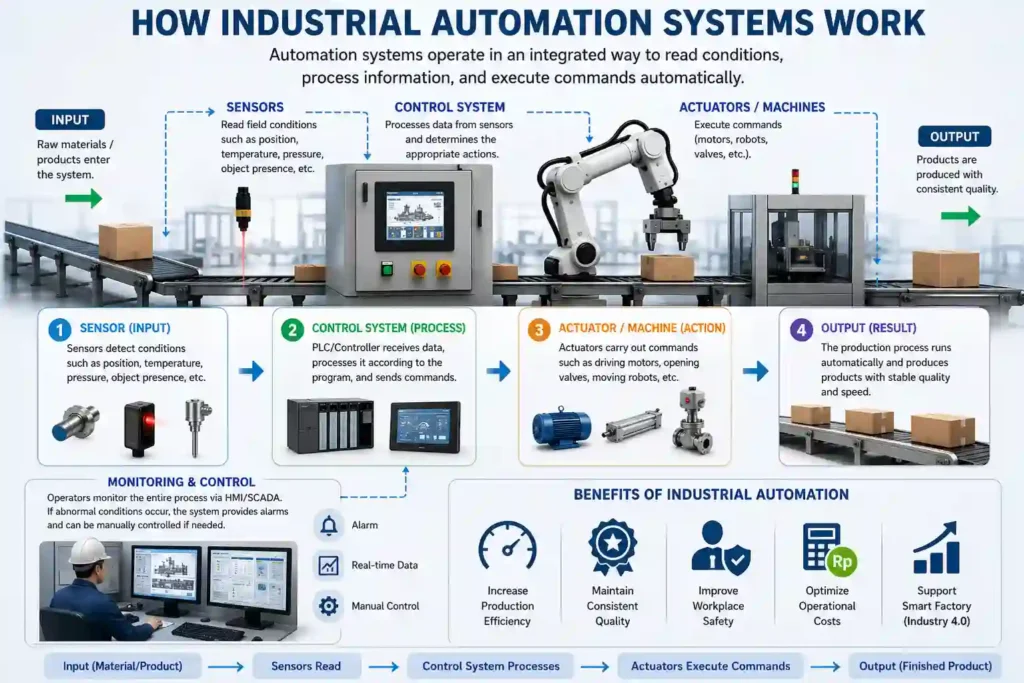
In practice, industrial automation systems operate through a closed-loop system involving three main technical pillars:
1. Sensors (Data Input) Sensors are the “eyes and ears” of the automation system. These devices continuously read physical conditions on the production floor, such as temperature anomalies, gas pressure, liquid viscosity, and object movement on a conveyor belt. This raw data is then transmitted to the control center in milliseconds.
2. Control Systems (PLC & SCADA) This is the “brain” of factory automation. Devices like a PLC (Programmable Logic Controller) or DCS (Distributed Control System) receive data from sensors, analyze it, and make instant decisions based on embedded programmed logic. On a broader scale, a SCADA (Supervisory Control and Data Acquisition) system is used by plant managers to monitor the entire infrastructure from a centralized dashboard screen.
3. Actuators (Output Executors) Once the PLC makes a decision, a signal is sent to the actuator to perform a physical action. Actuators can be servo motors, pneumatic valves, or industrial robotic arms. For example, on a packaging line, a sensor detects the product volume, the PLC calculates the safe limit, and the actuator precisely stops the material flow without a single drop spilling.
Why Modern Factories Must Transition to Automation Systems
The transition to automation often requires upfront capital expenditure (CAPEX). However, from a B2B perspective, this is a strategic move that offers several measurable advantages:
- Increased Operational Efficiency
Machines can operate 24/7 non-stop at a stable speed. This allows factories to meet mass production targets in a shorter timeframe. - Reducing Human Error and Maintaining Quality (Zero Defect)
With a programmed system, every product is assembled, filled, or cut with the exact same parameters every time, ensuring strict quality standardization. - Occupational Health and Safety (HSE)
Shifting workers from high-risk environments (extreme temperatures, chemical exposure, or heavy lifting) to supervisory roles minimizes workplace accident claims. - Accelerated Return on Investment (ROI)
Through features like predictive maintenance—where the automation system can detect failing components before the machine actually breaks down—companies can avoid costly downtime. Ultimately, this daily reduction in operational expenditure (OPEX) accelerates the return on investment.
Factory automation is no longer just a technological trend; it is the absolute foundation for the modern manufacturing industry. By integrating sensors, advanced control systems, and data analytics, companies not only increase production volume but also secure long-term profit margins.
For B2B industry players, investing in automation today is a guarantee to stay relevant and lead the market in the future. If your factory or production facility is planning to initiate this transition, nms automation is here as your strategic partner. As an experienced B2B industrial automation service provider, we are ready to help you design, integrate, and maintain an automation system tailored to your business’s scale and efficiency targets. Consult your factory’s needs with our team of experts today.
Frequently Asked Questions (FAQ)
Are factory automation systems only suitable for large-scale industries?
No. Today, industrial automation technology is highly scalable and customizable. Mid-sized factories (manufacturing SMEs) can start with partial automation, such as using smart conveyors or implementing a PLC system on one specific production line before executing a comprehensive expansion.
What is the estimated Return on Investment (ROI) from implementing automation?
ROI varies depending on the scale of implementation and the type of industry. However, with the reduction in operational costs (OPEX) from minimized downtime, energy efficiency, and increased mass production capacity, many modern factories record a break-even point (ROI) within 1 to 3 years post-implementation.
Will implementing automation completely halt the factory’s production schedule?
A well-planned implementation does not require a total shutdown. System integrators typically use a phased implementation approach or conduct installations during planned downtime (routine maintenance schedules) to ensure your product supply targets remain secure.
Will automation machines completely replace the human workforce?
Not entirely. Automation is designed to take over repetitive, heavy, and high-risk tasks. The human workforce remains crucial, but their roles shift from manual physical labor to supervisory roles, data analysis, and advanced machine maintenance. This actually encourages employee upskilling. NMS-Automation also offers automation machines that can work safely alongside humans, such as Co-Bots (Collaborative Robots) equipped with advanced safety features.
How do you maintain an automation system so it doesn’t break down quickly?
Modern automation systems like IIoT are usually equipped with predictive maintenance features. Sensors will trigger early warnings (alerts) to the SCADA system if any component begins to wear out or operates outside normal temperatures, allowing the technical team to perform repairs before severe damage occurs.
How do I start implementing automation for my factory?
The most crucial first step is to conduct a facility audit and design the right system architecture so your investment is efficient. You don’t have to do it alone. The expert team at nms-automation.com provides comprehensive B2B services starting from consultation, component procurement (sensors, PLCs, actuators), closed-loop system installation, to long-term maintenance support to ensure your factory achieves maximum performance.