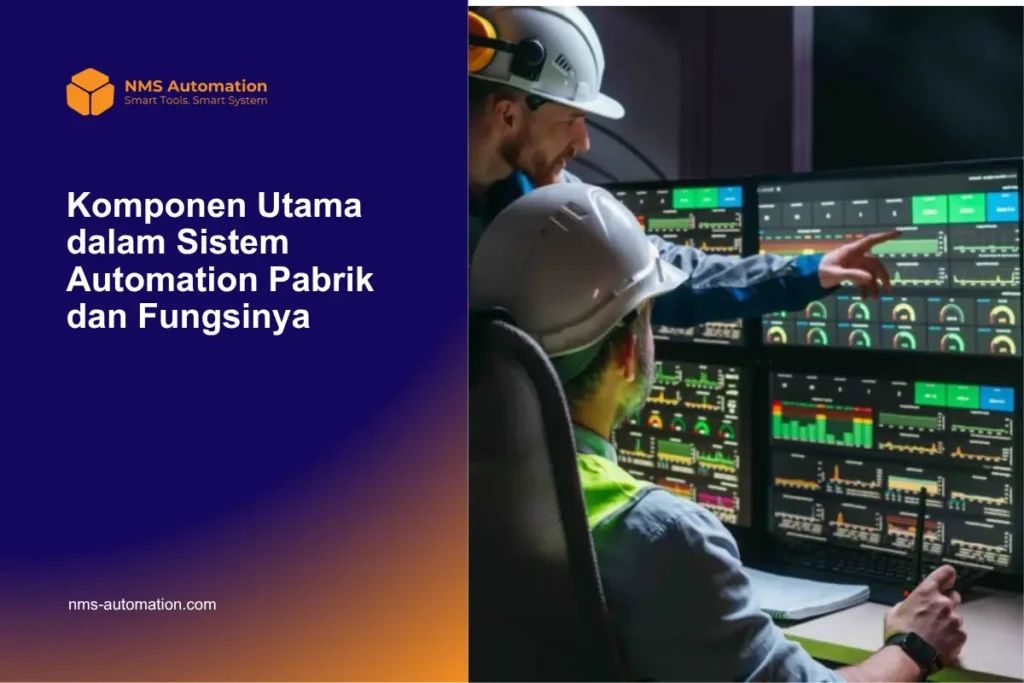

In building a reliable factory automation ecosystem, understanding the types of automation alone is not enough. Behind the rapid and precise movements of machines lies a fully integrated system architecture. For decision-makers in the manufacturing sector, understanding the core components of an automation system is crucial. It not only facilitates better communication with the engineering team but also helps in evaluating machine specifications, planning maintenance schedules, and calculating budget allocations (CAPEX/OPEX).
Table of Contents
Broadly speaking, an industrial automation system (whether fixed or flexible automation) is driven by four core components. Here is the breakdown:
1. Sensors (Data Input & Collection)
Sensors act as the “senses” in an automation system. In the era of the Industrial Internet of Things (IIoT) and Industry 4.0, the role of sensors goes beyond mere detection; they are the frontline for real-time data collection.
- Function is to detect physical changes in the production environment and convert them into electrical signals readable by the central system.
- Field Examples like Proximity sensors to detect the presence of products on a conveyor, thermocouples to monitor industrial oven temperatures, or machine vision (smart cameras) for sorting product defects (quality control) in milliseconds.
2. Control Systems (Controllers / The System’s Brain)
Raw data captured by sensors would be meaningless without a control system. This component is the “brain” that processes inputs and makes operational decisions.
- Function is to receive signals from sensors, match them against embedded programs/logic, and send commands to the Controller connected to the PLC.
- Field Application like The most common device on the factory floor is the PLC (Programmable Logic Controller). For a more massive and distributed factory scale, industries use a DCS (Distributed Control System). Modern control systems are designed to operate non-stop 24/7 with extremely strict fault tolerance levels.
3. Actuators (Output / The Muscle)
If sensors are the senses and the PLC is the brain, then actuators are the executing “muscles.” Actuators are mechanical or electromechanical components that convert command signals from the controller into physical movement.
- Function is to execute physical tasks such as pushing, lifting, rotating, or stopping material flow.
- Field Examples like Servo motors for precise robotic arm movements, pneumatic cylinders (air pressure-based) for packaging machines, and Variable Frequency Drives (VFD) to efficiently regulate pump motor speeds.
4. Human Machine Interface (HMI) & SCADA
Although the system runs automatically, human supervision remains the operational key. This is where the HMI (Human Machine Interface) acts as a communication bridge between human operators and machines.
- Function is to display real-time visualizations of production data, trigger alarms in case of anomalies (e.g., machine overheating), and provide access for operators to adjust parameters without modifying the program code (PLC).
- Field Application like While an HMI is typically a touchscreen panel located near the machine, on a larger (plant-wide) scale, factories utilize SCADA (Supervisory Control and Data Acquisition) systems. SCADA allows plant managers to monitor the entire production line from a central Control Room.
Integration is Key
The four components—Sensors, Control Systems, Actuators, and HMIs—operate within an interdependent closed-loop system. Advanced sensors won’t reach their potential if the actuator response is slow, and top-tier machines won’t be efficient if the HMI interface confuses the operator. It is the integration between these components that creates a modern factory with minimal downtime and high competitiveness.
Selecting and integrating the right components from various industrial brands requires high-level technical expertise. NMS Automation is here as your trusted system integrator. We provide end-to-end B2B services, from selecting precision sensors and PLC/SCADA programming to assembling control panels compliant with industrial safety standards. Contact our team of experts at nms-automation.com today to discuss upgrading or installing an automation system in your facility.
FAQ About This Article
Can modern sensors be integrated into older factory machines?
Yes, absolutely. This process is known as retrofitting. Conventional machines can be equipped with modern sensors and communication modules (like IIoT gateways) to extract production data and send it to the control system (PLC) without needing to purchase an entirely new main machine.
Why do factories use PLCs instead of standard computers (PCs) for control systems?
Although modern PCs are incredibly fast, PLCs are specifically designed (ruggedized) to survive harsh industrial environments—such as dust exposure, high vibrations, moisture, and power fluctuations. Additionally, PLCs operate on a Real-Time Operating System (RTOS), ensuring the machine won’t experience lags or crashes (like a PC’s blue screen) that could be fatal to the production line.
Can HMI and SCADA systems be monitored remotely from outside the factory?
With today’s Industrial Internet of Things (IIoT)-based automation architecture, SCADA systems can be connected to secure cloud servers. This allows Plant Managers or directors to monitor production dashboards, OEE (Overall Equipment Effectiveness), and machine status in real-time via a laptop or smartphone from anywhere.
Out of the four main components, which one is the most susceptible to damage?
Because actuators (like motors, cylinders, and valves) perform heavy mechanical and physical work, they experience faster wear and tear compared to sensors or PLCs. Therefore, implementing a predictive maintenance schedule is highly recommended so that wearing actuators can be replaced before causing total machine downtime.
Does my factory have to use the exact same brand for all automation components?
Not always. Using various brands (e.g., sensors from Brand A and a PLC from Brand B) is often necessary to get the best specifications for each line. However, integrating communication protocols between different brands requires specialized expertise. As an experienced System Integrator, NMS Automation has the skills to unify various components from leading industrial brands into a single, seamlessly running automation ecosystem without communication bottlenecks.